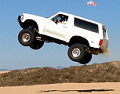
I'm just starting to look at widening the front and rear for my truck, so I'm sorry to jump into the discussion so late.
In regards to the deterioration in handling when changing front track width only, it was inevitable, whether it caused significant increase in oversteer ('loose') or understeer ('tight' or wanting to 'push' through corners). For a suspended vehicle (unlike a race kart), increasing rear track compared to front will cause an increase in oversteer / a decrease in understeer. The primary reason is that the wider the track is on either end, it reduces the amount of weight transfer to the outer wheel, and increases the amount the inside gets. Depending on a whole bunch of other factors (vehicle's center of gravity, tire construction, and most importantly the tire's coefficient of friction), that redistribution changes the overall grip the rear or front can achieve. So in short, the proportion between front and rear track width is really important.
Here's a snippet I stole off the web that explains some of it in mathematical detail (by Bellati from F1technical.net):
The easiest way to see this is using equations.

- Weight Transfer Formula
- Picture 2.png (2.17 KiB) Viewed 622 times
Increasing track width does not increase grip or lateral force, but decreases lateral weight transference.
Decreasing lateral weight transference:

- Tire Loading Graph
- Picture 3.png (58.33 KiB) Viewed 622 times
you improve lateral force coefficient (see the 900lb curve peak is higher than the 1800lb one). That means that the outer wheel will
loose some grip but the inner one will gain more than what the outer losses and thus overall (inner+outer) grip increases.