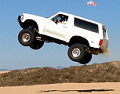
So I recently picked up a pair of Light Racing air bumps. They're the 3" travel models. My immediate concern is to install them on the front. I want a set for the rear but I've at least got rubber stops on the rear and nothing up front. Trying to decide if I should mount them in front of the front springs or behind them. BTW, the Bronco is a '69 with full width axles (Dana 44 High Pinion 8 lug front and Sterling 10.25 rear) and air suspension. If I mount them behind the bags, they'll be choked up on the radius arms with about a .7:1 motion ratio. Mounting in front of the bags might be difficult because there's not a lot of space available but they'd have close to a 1:1 motion ratio.
Opinions please.
Any pros and cons to choking the bump cans up on the arms, or should they always be as close to 1:1 as possible?
Tom
Air Bump Quandry
-
yellowbronco
- Posts: 19
- Joined: Wed Jun 05, 2013 1:18 pm
- Bronco Info: '69 with a 426 inch windsor, air suspension, full width axles, yadda yadda yadda
-
Rmc
- El Jefe
- Posts: 6028
- Joined: Tue Oct 09, 2012 10:22 pm
- Bronco Info: 94 bronco xlt prerunner
- Location: IE SoCal
- Contact:
Re: Air Bump Quandry
In my experience you just don't want the bump engaging till near the end of stroke, if you riding on the bump on the small stuff it makes for a much harsher ride. The later u can make the point of engagement the better but still making bump full compression coincide with shock stoke full bottom out position. The solid axel guys probably have particulars. I'm shure someone will chime in.
-
Agui-E7TE
- Posts: 1483
- Joined: Sat Jul 30, 2011 2:50 am
- Bronco Info: 89 Bronco w/ 6 in. skyjacker kit w/ dual Bilstein 5150 shocks up front and Deaver F53's in the rear
Re: Air Bump Quandry
This is totally unrelated as far as advice.. I've often wondered why everyone seems to call them air bumps when the reality is they're hydraulic bump-stops that are air charged. Oddly enough nobody calls their shocks air shocks..
Just thinking out loud.
As far as mounting them, I don't know how to explain it but something tells me the bump stop location would likely be best to mount either right over the diff (axle tube bump pad) or just behind it so it works with the arc of suspension travel. As far as choking the bumps... not sure what to make of this but I'm wondering if the amount of leverage to compress the bump-stops decreases from moving them back. Hopefully someone on here will chime in on the proper school of thought.
Just thinking out loud.
As far as mounting them, I don't know how to explain it but something tells me the bump stop location would likely be best to mount either right over the diff (axle tube bump pad) or just behind it so it works with the arc of suspension travel. As far as choking the bumps... not sure what to make of this but I'm wondering if the amount of leverage to compress the bump-stops decreases from moving them back. Hopefully someone on here will chime in on the proper school of thought.
-
Rmc
- El Jefe
- Posts: 6028
- Joined: Tue Oct 09, 2012 10:22 pm
- Bronco Info: 94 bronco xlt prerunner
- Location: IE SoCal
- Contact:
Re: Air Bump Quandry
Are the light racing bumps u got those inside the coil "jounce shock" ones? I remember them mounting them inside the coil spring on some jeeps to keep 1.1 location ratio I guess. Was a dirt sports article I recall.

Re: Air Bump Quandry
====Rmc wrote:Are the light racing bumps u got those inside the coil "jounce shock" ones? I remember them mounting them inside the coil spring on some jeeps to keep 1.1 location ratio I guess. Was a dirt sports article I recall.
The Jeep stuff is most unusual to me. Do a lift and sawing the rubber/elastomer bumps is typical. Then adding spacers seem to be the norm. My guess is its a way inexpensive way for the factory to deal with bumps and the aftermarket continues the practice. Obviously I fail to understand the concept?
What it means is one cycles the suspension then make guess as to what the compression is on the unknown stuff inside the coil. Works fine for trail use, but for competition what I see is N2 pressurized hydraulic bumps What King/Fox and others sell.
I see now that an aftermarket internal hydraulic bump is avilable. The hype is there is a gel inside it. Another inovation I fail to understand? Guys using them seem very happy.
Paul
-
yellowbronco
- Posts: 19
- Joined: Wed Jun 05, 2013 1:18 pm
- Bronco Info: '69 with a 426 inch windsor, air suspension, full width axles, yadda yadda yadda
Re: Air Bump Quandry
I used to work for the Nevada Automotive Test Center and we did a project for the General Motors Military Trucks. We built 8 technology demonstrators for their customer who happened to be the US Border Patrol. The trucks were 2500 HD's, four with the 8.1L engine and four with the diesel. All had Allisons. We installed 4" Rancho Lift Kits and then worked with Light Racing to develop jounce shock kits for them. This was before Light Racing came out with their own units so I think the jounce shocks we used were maybe Kings. Plus we installed custom valved Bilsteins at all 4 corners and air bags in the rear to handle the changing load (when they went out on shift they would be empty and when they returned they could have as many as 8 illegals in the containment unit mounted in the cargo box).
The rear jounce shocks were mounted right over the axle for about a 1:1 ratio and the fronts, being A-arm, hit on the lower control arm (the upper ball joint can't handle that kind of load) in about a .7:1 motion ratio if I remember correctly. These trucks performed amazingly well in all types of terrain. Then, as you added "passengers" in the back, they would do even better as the weight distribution evened out.
I suppose that I may be answering my own question, in conjunction with Rmc's response about not having the jounce shocks in contact at ride height. Maybe, whenever possible, mount them as close to 1:1 as you can?
The rear jounce shocks were mounted right over the axle for about a 1:1 ratio and the fronts, being A-arm, hit on the lower control arm (the upper ball joint can't handle that kind of load) in about a .7:1 motion ratio if I remember correctly. These trucks performed amazingly well in all types of terrain. Then, as you added "passengers" in the back, they would do even better as the weight distribution evened out.
I suppose that I may be answering my own question, in conjunction with Rmc's response about not having the jounce shocks in contact at ride height. Maybe, whenever possible, mount them as close to 1:1 as you can?
-
Rmc
- El Jefe
- Posts: 6028
- Joined: Tue Oct 09, 2012 10:22 pm
- Bronco Info: 94 bronco xlt prerunner
- Location: IE SoCal
- Contact:
Re: Air Bump Quandry
My 2 cents is basically let the shock do all the dampening it can before engagement. How and where u mount them is up to you but remember the shock can't dampen at a known rate( valving spring rate ect.) if mid stroke its having and additional progressive rate applied. The shocks job is to slow upward and downward motion, so ideally the speed at the point of engagement would be as slow as possible to avoid feeling that point. The farther up the stroke of the shock would equal a slower engagement speed in turn a softer feeling overall if the makes sence. I dunno just thinking out loud. Just keep in mind the most important aspect, make shure full bottom on the bump proceeds full bottom on the shock with some kind of safety margin: 1/2 inch/1/4 inch ect. Just don't let the shock piston hit the shock cap.yellowbronco wrote:I used to work for the Nevada Automotive Test Center and we did a project for the General Motors Military Trucks. We built 8 technology demonstrators for their customer who happened to be the US Border Patrol. The trucks were 2500 HD's, four with the 8.1L engine and four with the diesel. All had Allisons. We installed 4" Rancho Lift Kits and then worked with Light Racing to develop jounce shock kits for them. This was before Light Racing came out with their own units so I think the jounce shocks we used were maybe Kings. Plus we installed custom valved Bilsteins at all 4 corners and air bags in the rear to handle the changing load (when they went out on shift they would be empty and when they returned they could have as many as 8 illegals in the containment unit mounted in the cargo box).
The rear jounce shocks were mounted right over the axle for about a 1:1 ratio and the fronts, being A-arm, hit on the lower control arm (the upper ball joint can't handle that kind of load) in about a .7:1 motion ratio if I remember correctly. These trucks performed amazingly well in all types of terrain. Then, as you added "passengers" in the back, they would do even better as the weight distribution evened out.
I suppose that I may be answering my own question, in conjunction with Rmc's response about not having the jounce shocks in contact at ride height. Maybe, whenever possible, mount them as close to 1:1 as you can?
-
ChaseTruck754
- Spy/Ninja
- Posts: 9194
- Joined: Thu Jan 28, 2010 9:46 am
- Bronco Info: Don't have one - just old Ford trucks
- Location: Huntington Beach, CA
Re: Air Bump Quandry
Heard a bunch of Jeep type guys doing so Agui. Pirate4x4 type guys. Not common in our "world" though...Agui-E7TE wrote:This is totally unrelated as far as advice.. I've often wondered why everyone seems to call them air bumps when the reality is they're hydraulic bump-stops that are air charged. Oddly enough nobody calls their shocks air shocks...
This!! All of what he said makes perfect sense & is the way I go about things in my builds.Rmc wrote:My 2 cents is basically let the shock do all the dampening it can before engagement. How and where u mount them is up to you but remember the shock can't dampen at a known rate( valving spring rate ect.) if mid stroke its having and additional progressive rate applied. The shocks job is to slow upward and downward motion, so ideally the speed at the point of engagement would be as slow as possible to avoid feeling that point. The farther up the stroke of the shock would equal a slower engagement speed in turn a softer feeling overall if the makes sence. I dunno just thinking out loud. Just keep in mind the most important aspect, make shure full bottom on the bump proceeds full bottom on the shock with some kind of safety margin: 1/2 inch/1/4 inch ect. Just don't let the shock piston hit the shock cap.
Keep the bump away from contacting the arm until it is needed = the end of the shock stroke.
-
yellowbronco
- Posts: 19
- Joined: Wed Jun 05, 2013 1:18 pm
- Bronco Info: '69 with a 426 inch windsor, air suspension, full width axles, yadda yadda yadda
Re: Air Bump Quandry
So that definitely makes sense to mount the bump can/jounce shock/air bump so that it bottoms out just before the shock does. And, really, what other criteria matters as far as where in the suspension stroke the bump can is active. That's not a question, really more of a statement.
If I place the bump cans (I like that term so I think I'll stick with it) behind the air bags with a .7:1 motion ratio, the top 4.286" of suspension travel will be affected (3" travel bump can divided by .7 motion ratio=4.286"). Call it 4.5" with a little safety factor so there's no way the shock will end up limiting travel. This means my ride height needs to be significantly higher (than 4.5" from full bump) so I'm less likely to get into the bump cans on the "little stuff" and so the shock has more travel to control the axle before the bump can is engaged.
If I place the bump cans ahead of the air bags with a 1:1 motion ratio, only the top 3" of suspension travel will be affected. Again, adding in a little safety factor, call it 3.25" to avoid shock bottoming. This means that my ride height can be about 1.25" lower than the .7:1 example. Even though it doesn't sound like much, I like this because I've found that my Bronco handles better when the CG is lower (no surprise there).
If I place the bump cans (I like that term so I think I'll stick with it) behind the air bags with a .7:1 motion ratio, the top 4.286" of suspension travel will be affected (3" travel bump can divided by .7 motion ratio=4.286"). Call it 4.5" with a little safety factor so there's no way the shock will end up limiting travel. This means my ride height needs to be significantly higher (than 4.5" from full bump) so I'm less likely to get into the bump cans on the "little stuff" and so the shock has more travel to control the axle before the bump can is engaged.
If I place the bump cans ahead of the air bags with a 1:1 motion ratio, only the top 3" of suspension travel will be affected. Again, adding in a little safety factor, call it 3.25" to avoid shock bottoming. This means that my ride height can be about 1.25" lower than the .7:1 example. Even though it doesn't sound like much, I like this because I've found that my Bronco handles better when the CG is lower (no surprise there).
-
ChaseTruck754
- Spy/Ninja
- Posts: 9194
- Joined: Thu Jan 28, 2010 9:46 am
- Bronco Info: Don't have one - just old Ford trucks
- Location: Huntington Beach, CA
Re: Air Bump Quandry
Sounds like the 2nd option is the winner to me.
Personally I break everything down & cycle the suspension with everything tacked up & the shocks & bumps uncharged to check for clearances or anything else you might not have thought of coming into play. It takes more effort/time to do it RIGHT, but often ends up in less time fixing things later.
Personally I break everything down & cycle the suspension with everything tacked up & the shocks & bumps uncharged to check for clearances or anything else you might not have thought of coming into play. It takes more effort/time to do it RIGHT, but often ends up in less time fixing things later.
-
Rmc
- El Jefe
- Posts: 6028
- Joined: Tue Oct 09, 2012 10:22 pm
- Bronco Info: 94 bronco xlt prerunner
- Location: IE SoCal
- Contact:
Re: Air Bump Quandry
X2 on that.ChaseTruck754 wrote:Sounds like the 2nd option is the winner to me.
Personally I break everything down & cycle the suspension with everything tacked up & the shocks & bumps uncharged to check for clearances or anything else you might not have thought of coming into play. It takes more effort/time to do it RIGHT, but often ends up in less time fixing things later.
-
cs_drums
- Posts: 2912
- Joined: Wed Dec 22, 2010 10:39 am
- Bronco Info: 94 5.8 Bronco w/dreams of being finished
Re: Air Bump Quandry
Thats the only way to do it.ChaseTruck754 wrote:Sounds like the 2nd option is the winner to me.
Personally I break everything down & cycle the suspension with everything tacked up & the shocks & bumps uncharged to check for clearances or anything else you might not have thought of coming into play. It takes more effort/time to do it RIGHT, but often ends up in less time fixing things later.
You also want to position the bump so the point of impact stays the same though its stroke. Takes some trial and error.
-
yellowbronco
- Posts: 19
- Joined: Wed Jun 05, 2013 1:18 pm
- Bronco Info: '69 with a 426 inch windsor, air suspension, full width axles, yadda yadda yadda
Re: Air Bump Quandry
Hmm...maybe I should get that nitrogen kit sooner rather than later. I was going to avoid discharging the bump cans but you've got a good point about cycling everything.
The nice thing about the air bags is it's quick and easy to cycle the suspension. But I get some strange looks from people driving by when I do suspension work. Had a guy in a Toyota 'crawler drive by 3 or 4 times the other day when I was washing it. Dropped it all the way down to wash the roof and then aired it all the way up to get the sides and the lower body panels.
The nice thing about the air bags is it's quick and easy to cycle the suspension. But I get some strange looks from people driving by when I do suspension work. Had a guy in a Toyota 'crawler drive by 3 or 4 times the other day when I was washing it. Dropped it all the way down to wash the roof and then aired it all the way up to get the sides and the lower body panels.
-
Rmc
- El Jefe
- Posts: 6028
- Joined: Tue Oct 09, 2012 10:22 pm
- Bronco Info: 94 bronco xlt prerunner
- Location: IE SoCal
- Contact:
Re: Air Bump Quandry
That's awsome.yellowbronco wrote:Hmm...maybe I should get that nitrogen kit sooner rather than later. I was going to avoid discharging the bump cans but you've got a good point about cycling everything.
The nice thing about the air bags is it's quick and easy to cycle the suspension. But I get some strange looks from people driving by when I do suspension work. Had a guy in a Toyota 'crawler drive by 3 or 4 times the other day when I was washing it. Dropped it all the way down to wash the roof and then aired it all the way up to get the sides and the lower body panels.
-
Bondobob
- Posts: 504
- Joined: Mon Apr 12, 2010 10:41 am
- Bronco Info: 1987 XLT 5.0 in the family since new in May of 1987
- Location: Bakersfield CA
Re: Air Bump Quandry
Another vote for cycling....
I adapted some used fox 2.0 x4" to the front of my coil buckets and had to find the compromise spot where stuff would clear, tuck close to the frame rail and account for the arch the beam moves in.
I went with the last 25% rule of thumb with my 10" travel shocks so I am in my bumps that are now limited to 2.25" of travel in the last 2.5" of travel of the shock. So far so good and its pretty nice on big hits.
I adapted some used fox 2.0 x4" to the front of my coil buckets and had to find the compromise spot where stuff would clear, tuck close to the frame rail and account for the arch the beam moves in.
I went with the last 25% rule of thumb with my 10" travel shocks so I am in my bumps that are now limited to 2.25" of travel in the last 2.5" of travel of the shock. So far so good and its pretty nice on big hits.
-
Dezertbronco
- Posts: 652
- Joined: Fri Jan 22, 2010 12:29 am
- Bronco Info: 1990 Bronco EB
- Location: Highland, CA.
Re: Air Bump Quandry
Bondobob wrote:Another vote for cycling....
I adapted some used fox 2.0 x4" to the front of my coil buckets and had to find the compromise spot where stuff would clear, tuck close to the frame rail and account for the arch the beam moves in.
I went with the last 25% rule of thumb with my 10" travel shocks so I am in my bumps that are now limited to 2.25" of travel in the last 2.5" of travel of the shock. So far so good and its pretty nice on big hits.
Can you post photos of the setup that you described, very interested.